Kaiser Permanente
Content Taxonomy
The architecture and taxonomy that makes healthcare content reusable and personalizable.
Situation
KP invested in Adobe Experience Manager, a new platform to support the organization’s digital transformation strategy.
We needed to change the way we planned, created, and delivered content to fully leverage AEM’s capabilities. The feature I was most excited about enabled us to syndicate content out to multiple platforms from a single source.
This new feature was key to helping us solve a big problem. We had different writers throughout the organization creating similar copies for different platforms. It resulted in duplicated efforts and inconsistencies throughout our digital experiences.
How could we move toward creating content once and using it everywhere in a complex organization with hundreds of content creators across the country? And how do we integrate into our existing UX design and content delivery process to change the way we create and deliver content?
Tasks
To start, we wanted to focus on sharing content between kp.org and the flagship mobile app. I had 3 main tasks.
- Identify all content types in the content ecosystem.
- Develop a hierarchical list of all content types and standard naming conventions that would be the foundation for content reuse.
- Socialize across the organization and increase adoption.
Actions
I assessed the current digital ecosystem for kp.org and the app and collaborated with writers across the organization to inventory the current state.
Then, I analyzed the content structure and topics of the content inventory and sorted the content into distinct content types. In multiple working sessions, I led stakeholders through exercises to refine the content types. To validate my work, I then stress-tested the content types in a few beta projects.
Once I felt the content types were solid, I socialized the taxonomy across the Digital and Marketing organizations (writers, designers, Producers, and senior management). My goal was to move the organization toward a content-as-a-service model, with a single content repository so that authors can write once and use that content across platforms.
After getting buy-in from the various groups, I worked with product designers, content designers, and information architects to determine where in the UX design delivery process we could define the content elements for an experience.
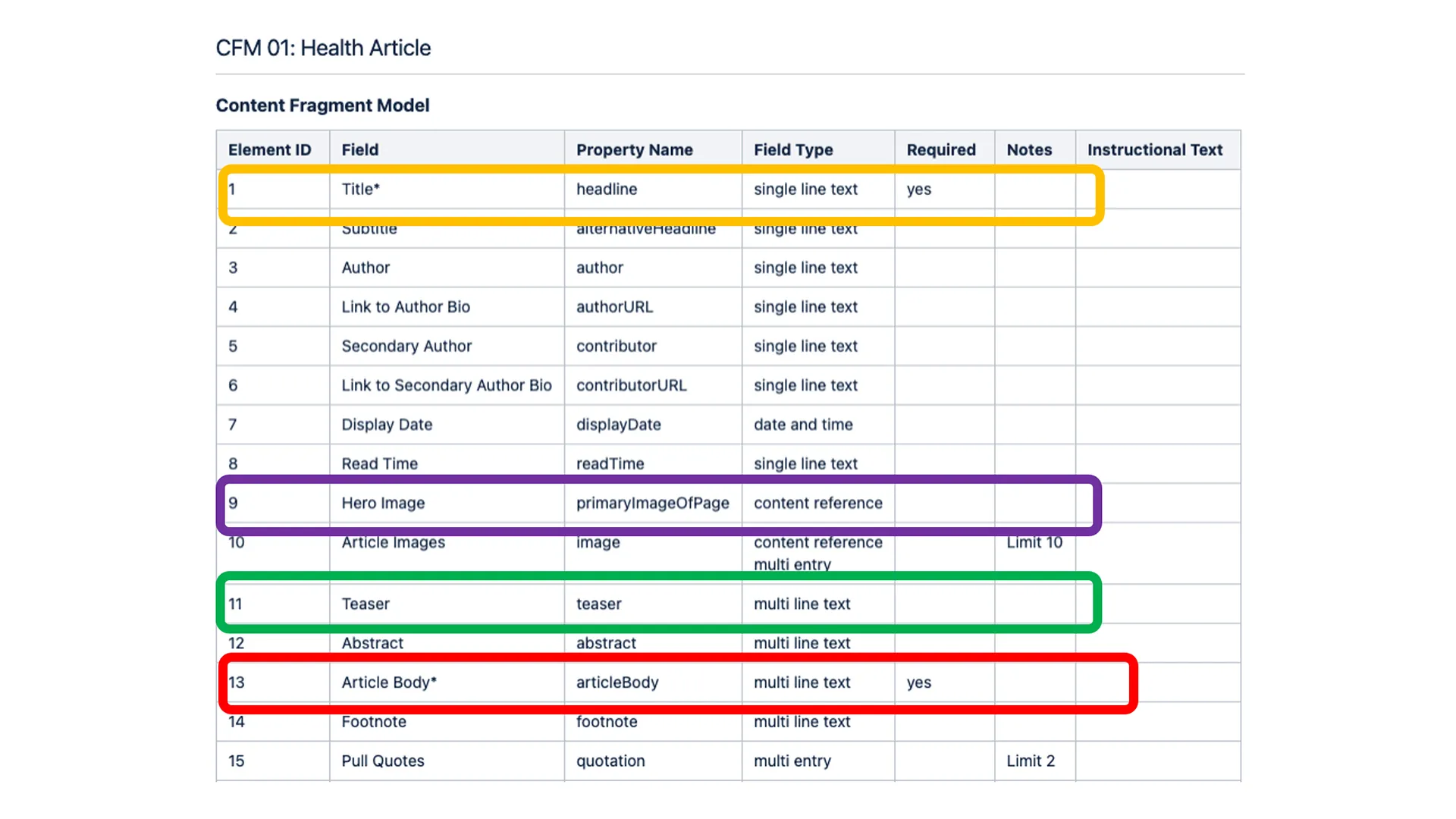
We determined that we’d identify the content elements on the final UX wires after the designs had gone through stakeholder review. Each content element had a unique identifier that aligned with the site map, so we had a way of easily tracking each element in the CMS.
Results
When I left KP, the following content types were syndicated to kp.org web and the mobile app from a single source:
- Health articles
- Promotions
- Terms & conditions
- Q&As
The taxonomy gave more definition and clarity to content work enabling teams that create, consume, author, and test content to work more efficiently together and improve the process.
The taxonomy also became the foundation for creating a system based on structured content that enables:
- Editorial and authoring efficiencies
- Technical development and testing efficiencies
- Content reuse
- Content discovery